


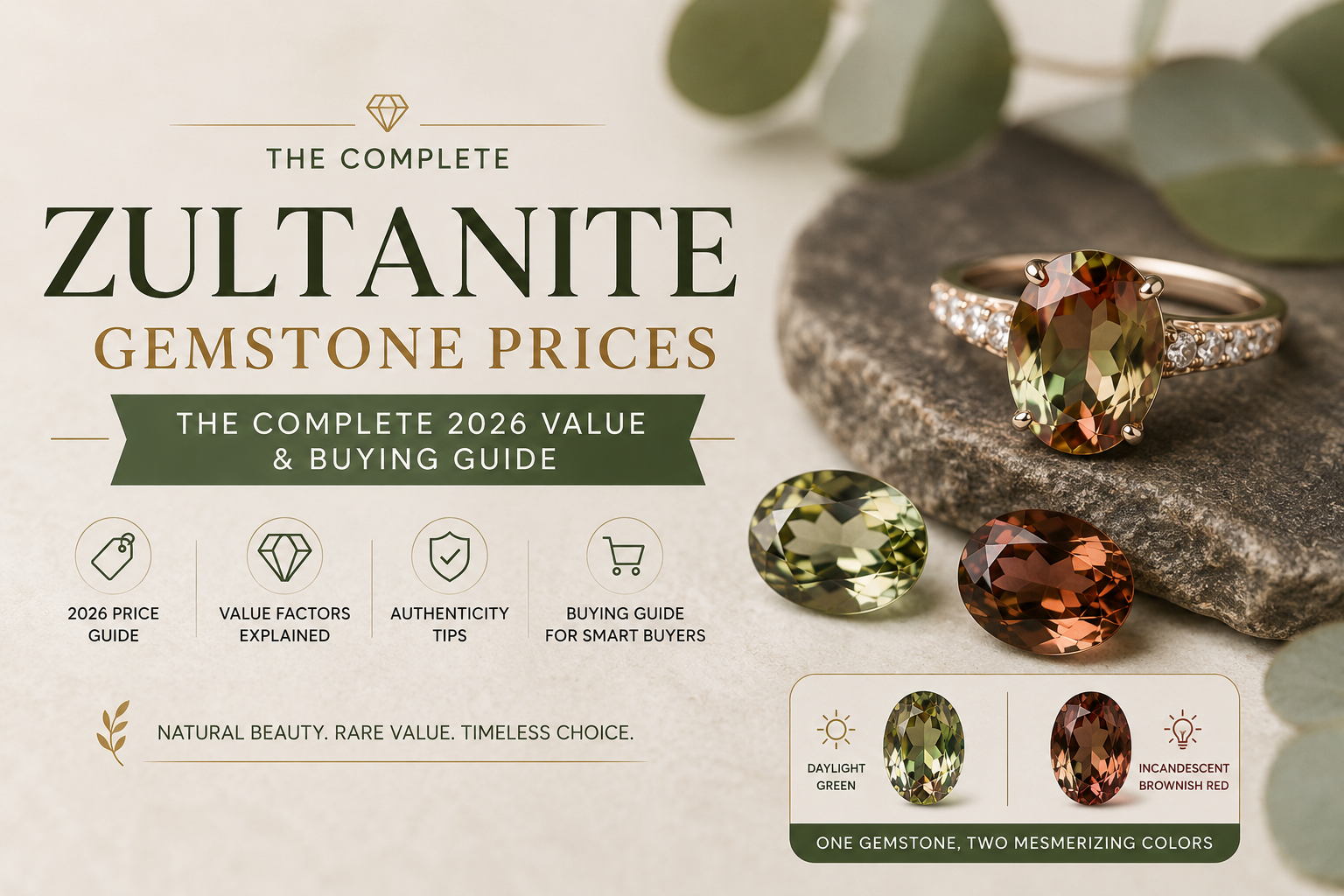
Zultanite Gemstone Prices: The Complete 2026 Value & Buying Guide
Zultanite is one of the rarest gemstones on Earth mined from a single deposit in the mountains of Turkey, naturally color-changing, and never treated. So when people ask about zultanite gemstone prices, the honest answer is: it depends, and the range is enormous. A small commercial stone can cost less than $50 a carat, while a large, fine-quality gem with a dramatic color shift can command $10,000 a carat or more.
This guide breaks down exactly what zultanite costs per carat in 2026, what makes one stone worth ten times another, how loose gems compare to finished jewelry, and how zultanite stacks up against its famous rival, alexandrite. At GU, we work with rare color-change gems every day, and our goal here is simple: give you the real numbers and the context to buy smart whether you’re a first-time buyer, a collector, or an investor.
Let’s start with the prices, because that’s what you came for.
Zultanite Gemstone Prices at a Glance (Quick Answer)
If you only have 30 seconds, here’s the short version. Zultanite is sold by the carat, and price climbs sharply with both size and the quality of the color change.
| Carat weight (loose, faceted) | Commercial quality | Good quality | Fine / dramatic color change |
| Under 1 ct | $30 – $150/ct | $100 – $300/ct | $250 – $500/ct |
| 1 – 2 ct | $150 – $400/ct | $300 – $700/ct | $500 – $1,200/ct |
| 3 – 5 ct | $400 – $900/ct | $700 – $1,500/ct | $1,200 – $3,000/ct |
| 5 – 10 ct | $700 – $1,500/ct | $1,200 – $2,500/ct | $2,500 – $5,000/ct |
| 10 ct and above | $1,500 – $3,000/ct | $3,000 – $6,000/ct | $5,000 – $10,000+/ct |
These are approximate retail ranges for genuine, certified zultanite from reputable dealers. Wholesale prices run lower roughly $50 to $3,000 per carat depending on size and grade. Marketplace listings (Etsy, Amazon, Alibaba) often show much lower numbers, but authenticity at those prices is frequently questionable.
The takeaways:
- A 1-carat zultanite with a nice color change typically costs $300–$700 per carat at retail, though fine examples can exceed $1,000.
- Price per carat rises as stones get bigger, because large gem-quality crystals are extraordinarily rare. This is the opposite of how most affordable gems behave.
- The color change its strength, number of hues, and visibility in everyday light is the single biggest driver of value.
- Zultanite is far cheaper than alexandrite (usually 5–20% of the price) while offering an arguably more dramatic, multi-color shift.
- Finished jewelry ranges from around $1,000 for a small silver piece to $50,000+ for a large gold-and-diamond design.
Now let’s unpack each of those points in detail.
How Much Does Zultanite Cost Per Carat?
The carat is the universal unit for pricing gemstones, and zultanite is no exception. But zultanite has a pricing quirk that surprises newcomers: the price per carat increases as the stone gets larger.
With most budget and mid-range gems, you pay a relatively flat rate per carat, or only a modest premium for size. Zultanite behaves more like alexandrite, ruby, or fine sapphire the per-carat price escalates because each step up in size represents a dramatic jump in rarity. Miners reportedly have to move roughly two tons of bauxite ore to recover a single carat of gem-quality material, and only about 2% of what’s mined is suitable for faceting. Large, clean crystals with strong color change are the rarest of the rare.
Retail vs. wholesale pricing
There are two price worlds for zultanite, and knowing which one you’re shopping in matters.
Retail is what you pay at a jewelry store, an established online gem dealer, or a branded boutique. Retail zultanite generally runs from a few hundred dollars per carat for smaller stones up to $10,000 per carat for exceptional large gems. You’re paying for the dealer’s curation, authentication, guarantees, and overhead but also for confidence that the stone is real.
Wholesale is the dealer-to-dealer or mine-to-cutter price, typically $50 to $3,000 per carat depending on size and quality. Most consumers can’t access true wholesale, and “wholesale” pricing advertised to the public should be treated with healthy skepticism.
Calibrated and commercial stones
At the lower end, small calibrated zultanite uniform stones cut to standard millimeter sizes for mass-produced jewelry can be found for $30 to $200 per carat when under 5 carats. These are the stones you’ll see in inexpensive sterling silver rings and earrings. They’re genuine, but the color change tends to be subtler and the cut more basic. They’re a great entry point if you love the phenomenon but aren’t ready to invest serious money.
The key thing to understand is that “price per carat” is not a single number for zultanite it’s a spectrum that depends heavily on the factors we’ll cover next.
What Determines Zultanite’s Price? Six Value Factors
Two zultanite stones of identical weight can differ in price by a factor of ten. Here’s what separates a $100 stone from a $1,000 stone.
1. Color change quality (the #1 factor)
Zultanite’s entire identity rests on its ability to change color, so it’s no surprise this is the most important value driver. Under daylight or fluorescent light, fine zultanite shows a kiwi or yellow-green hue. Under incandescent or warm indoor light, it shifts to champagne and golden tones. And under candlelight or firelight, the best stones glow raspberry pink to a soft red.
What pushes a stone into premium territory:
- A dramatic, obvious shift green-to-pink is considered the gold standard.
- Multiple distinct hues stones that show three or more clear colors command the highest prices.
- Visibility in normal lighting a color change you can actually see when you walk from a sunny window to a lamp-lit room, not one that only appears under special lab lights.
A weak, muddy color changer might sell for around $100 per carat. A stone with a vivid, multi-hue performance can hit $800 per carat or far more at the same size. This is the difference that experienced buyers obsess over.
Zultanite is also pleochroic, meaning it shows different colors when you simply turn it and view it from different angles under a single light source. Strong pleochroism adds to the visual drama and the price.
2. Carat weight and size
As covered above, size is a massive price multiplier for zultanite. The overwhelming majority of faceted zultanite weighs under 2 carats. Anything over 3 to 5 carats is genuinely rare, and stones above 5 carats make up only a small fraction of total production. Eye-clean stones above 7 carats sit in the top tier of what’s available anywhere in the world.
Because larger stones also tend to show stronger, more saturated color change, size and quality often reinforce each other which is why per-carat prices climb so steeply at the top end.
3. Clarity
Clarity describes how free a stone is from internal inclusions. Rough zultanite is heavily included, and much of it is unusable. But the standard for cut, sold zultanite is eye-clean no inclusions visible to the naked eye at normal viewing distance.
Because eye-clean is the baseline expectation, visibly included faceted zultanite should be avoided or heavily discounted. Under 10x magnification, even good stones reveal natural inclusions (this is actually one way gemologists confirm a stone is natural rather than synthetic), but those shouldn’t be visible without a loupe.
4. Cut and faceting
Zultanite is notoriously difficult to cut. It has perfect cleavage, meaning it can split cleanly along certain planes if a cutter applies pressure the wrong way a single mistake can destroy a valuable rough crystal. On top of that, the cutter has to orient the stone precisely to maximize the color change and the brilliance.
For these reasons, virtually all genuine zultanite is cut by a small number of highly skilled lapidaries in select locations worldwide. Fancy and precision cuts command the highest premiums, while a skilled cut can make a $300 stone look like it’s worth $500. Conversely, a poorly oriented cut can hide the very color shift that gives the gem its value.
5. Origin and authenticity
All genuine zultanite comes from one source: the İlbir Mountains in Muğla province, southwest Turkey, at elevations above 4,000 feet. This single-origin status is part of what makes the gem so collectible and why authenticity documentation carries real weight in pricing.
Authentic zultanite is typically sold with a Zultanite Authenticity Guarantee Card (a plastic card with an embedded hologram and sourcing details). Stones with proper certification and documentation are worth more than undocumented material of the same apparent quality, because the buyer is paying for proof.
6. Treatment (or rather, the lack of it)
Here’s a genuine selling point: zultanite is never treated, heated, irradiated, or enhanced in any way. Its color and color change are 100% natural. In the gemstone world, where many stones are routinely heat-treated or otherwise enhanced, an untreated natural gem carries a premium and appeals strongly to purists and collectors. The industry enhancement code for zultanite is “N” Not Enhanced.
Zultanite Price by Carat Weight: A Detailed Breakdown
Let’s get specific about what you can expect to pay at each size tier. These ranges reflect genuine, dealer-sold zultanite of decent-to-fine quality.
Under 1 carat
Small zultanite is the most affordable and accessible. Calibrated commercial stones can run as low as $30–$150 per carat, while better single stones with a noticeable color change land around $100–$500 per carat. The trade-off: stones under 1 carat usually have a less saturated, less dramatic color change, simply because there’s less material for light to travel through.
This is the realm of affordable silver jewelry and “first zultanite” purchases. If you want to own the gem without a major outlay, this is where to look.
1 to 2 carats
This is the sweet spot for most buyers large enough to show a real color shift, small enough to remain attainable. Expect roughly $150–$700 per carat for good quality, with fine examples reaching $1,200 per carat. A well-cut 1.3-carat stone with a pleasant change commonly retails in the $500–$900 total range.
3 to 5 carats
Now we’re entering rare territory. Stones in this range show fuller, more dramatic color change and are far less common. Prices generally run $400–$1,500 per carat for good-to-very-good quality, climbing to $3,000 per carat for fine, vivid stones. A standout 4-carat gem can easily be a four-figure purchase.
5 to 10 carats
A zultanite over 5 carats is considered large and genuinely scarce. These stones typically display the strongest color change and brilliance. Expect $700–$2,500 per carat for solid quality, and $2,500–$5,000 per carat for exceptional examples with dramatic, multi-hue shifts and excellent clarity.
10 carats and above
This is collector and investment territory. Gem-quality zultanite above 10 carats is rare enough that each stone is essentially unique. Prices start around $1,500–$3,000 per carat and climb to $5,000–$10,000+ per carat for the finest material. For reference, the largest zultanite ever cut a 96-carat gem named the “Sultan’s Shield” is a museum-grade rarity that has been set into high jewelry.
| Size tier | Typical retail range (per carat) | Rarity |
| Under 1 ct | $30 – $500 | Common |
| 1 – 2 ct | $150 – $1,200 | Available |
| 3 – 5 ct | $400 – $3,000 | Rare |
| 5 – 10 ct | $700 – $5,000 | Very rare |
| 10 ct+ | $1,500 – $10,000+ | Exceptional |
Zultanite Jewelry Prices: Rings, Pendants & Earrings
So far we’ve talked about loose stones. But most people buy zultanite set in jewelry, and that changes the math.
The setting premium
A finished piece costs significantly more than the loose stone inside it. As a rule of thumb, mounting a zultanite into jewelry adds roughly 50% to 200% on top of the loose stone price, depending on the metal, the design complexity, and any accent stones like diamonds.
What you’ll actually pay
- Sterling silver pieces with small calibrated zultanite: often $30–$150 for simple rings, pendants, and earrings. These are the affordable entry pieces you’ll see on Etsy and similar marketplaces.
- Gold settings with a quality 1–2 carat center stone: typically $800–$3,000+, driven by the gold weight and the stone’s grade.
- Designer and high-jewelry pieces with large fine zultanite and diamond accents: $5,000 to $50,000 and beyond.
Overall, authentic zultanite jewelry generally spans from about $1,000 to $50,000 depending on the stone, the metal, and the maker.
A money-saving tip
If budget matters, two choices make a real difference. First, champagne-dominant stones (where the warm indoor color leads) often cost around 25% less than green-primary stones, while still delivering a lovely color shift. Second, sterling silver settings dramatically cut the total cost versus gold or platinum, without affecting the beauty of the gem itself. For pendants and earrings which take less daily abuse than rings silver is a perfectly practical choice.
Zultanite vs. Alexandrite: Price Comparison
The most common comparison buyers make is between zultanite and alexandrite, the legendary color-change gem. Both shift color with lighting, but the price gap between them is dramatic and it’s one of zultanite’s biggest selling points.
| Feature | Zultanite | Alexandrite |
| Mineral family | Diaspore | Chrysoberyl |
| Mohs hardness | 6.5 – 7 | 8.5 |
| Sources | One (Turkey) | Russia, Brazil, Sri Lanka, Madagascar, Tanzania, India |
| Color change | Up to 4+ hues (green → champagne → pink) | Typically 2 (green → red) |
| Fine 1 ct price (retail) | $500 – $1,200/ct | $15,000 – $70,000/ct |
| Top-tier price | $10,000+/ct | $100,000+/ct |
| Availability in large sizes | Yes | Extremely rare |
| Treatment | Always untreated | Usually untreated |
Why zultanite is the affordable alternative
Fine alexandrite is one of the most expensive gemstones on Earth often pricier than diamonds. High-quality stones run $15,000 to $70,000 per carat, and the rarest specimens exceed $100,000 per carat. Zultanite, by contrast, typically costs just 5% to 20% of alexandrite’s price for a comparable size.
But it’s not only about being cheaper. Zultanite arguably offers a richer visual experience: where alexandrite generally shifts between two colors (green and red), zultanite can move through green, champagne, gold, and raspberry, with added pleochroic flashes. And while alexandrite over a couple of carats is almost impossible to find, large zultanite stones genuinely exist.
The trade-off
Alexandrite’s advantage is hardness and durability. At 8.5 on the Mohs scale, it’s tougher than zultanite’s 6.5–7 and better suited to rough daily wear in a ring. Zultanite’s perfect cleavage also makes it more vulnerable to a sharp knock. So if you want a daily-wear engagement ring that will take decades of abuse, alexandrite (or a protective setting for zultanite) is the more practical choice. If you want extraordinary color-change beauty at a fraction of the cost, zultanite wins on value.
Many buyers use zultanite as an affordable June birthstone alternative to alexandrite for exactly this reason.
Zultanite vs. Other Color-Change Gemstones
Alexandrite gets the headlines, but it isn’t zultanite’s only rival. Several gems shift color with lighting, and knowing where zultanite sits among them helps you judge whether its price is fair.
| Color-change gem | Mineral | Mohs hardness | Typical fine price (per carat) | Notes |
| Zultanite | Diaspore | 6.5 – 7 | $500 – $1,200 (1 ct fine) | Up to 4+ hues; single source; untreated |
| Alexandrite | Chrysoberyl | 8.5 | $15,000 – $70,000+ | Most prestigious; green-to-red; very durable |
| Color-change garnet | Garnet | 6.5 – 7.5 | $500 – $3,000+ | Dramatic blue-green to purple/red shifts; rare |
| Color-change sapphire | Corundum | 9 | $1,000 – $4,000+ | Blue to purple/violet; extremely durable |
| Color-change fluorite | Fluorite | 4 | Under $50 (collector) | Too soft for everyday jewelry |
A few takeaways from the comparison:
- Zultanite is mid-priced among genuine color-change gems far cheaper than alexandrite, broadly comparable to (and often more dramatic than) color-change garnet and sapphire, and vastly more valuable than soft collector stones like color-change fluorite.
- On durability, zultanite sits in the middle. Color-change sapphire (Mohs 9) and alexandrite (8.5) are tougher and better for daily-wear rings; zultanite and color-change garnet are softer and benefit from protective settings.
- On color drama, zultanite competes at the top. Its multi-hue shift and pleochroism rival or exceed most alternatives, which is a big part of why it has built such a devoted following despite being relatively new to the market.
If your priority is the most dazzling color change per dollar, zultanite makes a strong case. If your priority is a hard, rugged stone for an everyday ring, color-change sapphire may serve you better at a similar price point.
Why Is Zultanite So Rare and Valuable?
Understanding zultanite’s rarity explains its pricing. A few factors combine to make it one of the scarcest gems in the trade.
A single source on the entire planet
Gem-quality zultanite is found in just one vein within the İlbir (Anatolian) Mountains of southwest Turkey. No other deposit anywhere produces this material at gem quality. If you own a zultanite, it came from that one mountain range.
An extraordinarily low yield
Miners move enormous quantities of bauxite to extract usable rough, and only around 2% of mined material is gem quality. Translating that to finished stones, it can take roughly two tons of ore to yield a single carat of cuttable gem. Most rough must be discarded.
Brutal cutting losses
Even after good rough is found, zultanite’s perfect cleavage means cutters lose much of the material and risk destroying a crystal entirely during faceting. Only a handful of master lapidaries worldwide cut it reliably.
Controlled supply and trademark
The names “Zultanite” and “Csarite” are trademarked, and only material mined and sold through licensed affiliates can legally carry those names. This controlled supply chain keeps quality high and reinforces the gem’s exclusivity.
Finite reserves
Because there’s only one deposit, the supply is inherently limited. Many in the trade view current availability as a window that won’t stay open forever part of the gem’s appeal to collectors and investors.
What Is Zultanite? A Quick Background
If you’re newer to the gem, here’s the essential context behind the prices.
Zultanite is the trademarked trade name for gem-quality, color-changing diaspore mined in Turkey. Diaspore itself is an aluminum oxide hydroxide mineral (chemical formula AlO(OH)) that occurs in several places worldwide, but Turkish diaspore is considered the finest, and only the color-change material from the İlbir Mountains earns the Zultanite name.
Zultanite, Csarite, diaspore, and Turkizite what’s the difference?
This naming situation confuses a lot of buyers, so let’s clear it up:
- Diaspore is the underlying mineral. Most diaspore worldwide is not gem quality.
- Zultanite is a trademarked name for fine color-change Turkish diaspore, honoring the 36 sultans of the Ottoman Empire (which ruled from 1299 to 1923).
- Csarite is a different trademarked name for the same Turkish material, created after a well-documented business split between the gem’s two pioneers. Both names refer to essentially the same gem from the same region.
- Turkizite and Ottomanite are additional, non-trademarked trade names you’ll occasionally see.
In short: Zultanite and Csarite are premium branded names for the same rare Turkish color-change diaspore. The branding affects marketing and documentation more than the underlying gem.
Key properties at a glance
| Property | Detail |
| Mineral | Diaspore (aluminum oxide hydroxide) |
| Mohs hardness | 6.5 – 7 |
| Crystal system | Orthorhombic |
| Refractive index | 1.68 – 1.75 |
| Specific gravity | 3.30 – 3.39 |
| Luster | Vitreous to pearly |
| Cleavage | Perfect |
| Transparency | Translucent to transparent |
| Cause of color change | Trace manganese (and chromium) |
| Source | İlbir Mountains, Muğla, southwest Turkey |
| Treatment | None always natural |
The colors of zultanite
Under different light, fine zultanite typically shows:
- Daylight / fluorescent: kiwi green to yellow-green
- Incandescent / warm indoor: champagne, golden yellow
- Candlelight / firelight: raspberry pink to soft red
You may also see sage, khaki green, pale gold, purplish-pink, peach, and ginger tones along the way part of what makes each stone feel alive.
A Brief History of Zultanite
Zultanite’s story is surprisingly modern and surprisingly dramatic and it helps explain why the gem is priced and branded the way it is today.
The underlying mineral, diaspore, was first identified in the early 1800s in Russia’s Ural Mountains. But gem-quality diaspore is essentially a 20th- and 21st-century discovery, and for a long time the material was dismissed as too difficult to cut and too heavily included to bother with.
The modern era began with two people: Stephen Kotlowski, an American master gem cutter, and Murat Akgun, a Turkish jeweler. In the mid-1990s they founded a company, Golden Land Trading, and set out to bring Turkish diaspore to a wider audience. Kotlowski’s cutting skill was central in 1995 he won an AGTA Spectrum “Cutting Edge” Award for faceting a large fan-shaped diaspore, proving the material could become a serious fine gem.
By 2005, Akgun had secured the legal mining rights and the financial backing to expand the venture into Zultanite Gems LLC. The pair wanted a trade name that would set their high-quality, color-change gems apart from ordinary diaspore and give the stone marketing power. They cycled through options “Ottominite,” “Sultanite” before landing on “Zultanite,” a tribute to the 36 sultans who ruled the Ottoman Empire from 1299 to 1923. Commercial gemstone mining began around 2006, and a steady commercial supply reached the market by 2007.
In 2011, Kotlowski faceted the largest zultanite ever cut: the 96-carat “Sultan’s Shield.” A year later, celebrated British jeweler Stephen Webster set the stone into a luxury jewelry creation, cementing zultanite’s place in high jewelry.
Then came the drama. A legal dispute eventually saw Akgun lose his rights to the company, the Zultanite name, and the diaspore inventory. Forced to start over, he created a new trademarked name for the same Turkish material: Csarite. The two sides ultimately resolved their differences and remain on good terms but the episode is why two competing trademarked names exist today for what is essentially the same rare gem.
This recent, single-source, tightly controlled history is a big part of why zultanite carries the premium and the exclusivity it does.
Is Zultanite a Good Investment?
This is one of the most common questions buyers ask, and it deserves a balanced answer rather than hype.
The case for zultanite as an investment
The bullish argument is straightforward: zultanite is genuinely rare, single-sourced, untreated, and finite. Supply comes from one mountain, and there’s no guarantee that deposit will produce indefinitely. As global awareness of the gem grows especially in luxury markets demand could rise against a fixed or shrinking supply, which would support prices over time. Large, clean, vivid stones in particular are the kind of rare asset that tends to hold value well. Collectors who got in early on other niche gems have sometimes been rewarded.
The cautions
Now the realistic counterweight. Zultanite is classified as a semi-precious stone, and it trades in a relatively niche market. That means:
- Liquidity is limited. Reselling a zultanite isn’t as simple as selling gold or a recognized diamond. You need to find a buyer in a small market, and you typically won’t recover retail prices on resale.
- Pricing is opaque. As one long-running collector forum discussion shows, there’s genuine disagreement in the trade about what zultanite is really worth, and advertised prices don’t always reflect actual sale prices. High asking prices on websites don’t mean a stone will sell at that figure.
- Durability constraints make it less universally desirable than a harder, more famous stone.
The bottom line
Zultanite can be a rewarding purchase for someone who loves rare color-change gems and is buying primarily for beauty and enjoyment, with appreciation as a possible bonus. If your only goal is financial return, treat it the way you’d treat any niche collectible: do thorough research, buy the best quality you can, insist on authentication, and don’t overpay based on rarity claims alone. We’re a gemstone resource, not financial advisors, so consider your own situation and risk tolerance before making a significant purchase.
How to Buy Authentic Zultanite (and Avoid Fakes)?
Because zultanite is rare and valuable, the market attracts counterfeits, simulants, and overpriced material. Here’s how to protect yourself.
Demand authentication
Genuine zultanite is typically accompanied by a Zultanite Authenticity Guarantee Card a plastic card with an embedded hologram and details about the stone’s sourcing and origin. For any significant purchase, also ask for an independent gemological certificate, since lab testing is the only definitive proof that a stone is natural diaspore rather than a synthetic or simulant.
Watch for these red flags
- Prices that are too good to be true. Genuine zultanite rarely sells below about $50 per carat. A “large vivid zultanite” for pocket change is almost certainly fake or misrepresented.
- No proof of color change. Reputable sellers provide videos showing the stone shifting color under different light sources. If a seller can’t or won’t, walk away.
- Vague origin claims. Authentic documentation specifies the Turkish (Anatolian / İlbir) source. Sellers who are fuzzy about where the stone came from are a warning sign.
- Visible inclusions. Faceted zultanite should be eye-clean. Visibly included material is below standard.
Synthetics and simulants to know about
Fake “zultanite” commonly takes the form of man-made color-change glass that looks yellow-green under fluorescent light and brownish-yellow under incandescent a duller, less complex shift than the real thing. Manufacturers sometimes use elements like neodymium to mimic a color change. There are also lab-grown (hydrothermal synthetic) diaspores, occasionally marked “g/t” on their labels. None of these are genuine natural zultanite, and they should be priced and described as synthetics.
Where to buy
Stick to established gem dealers, reputable jewelers, and authorized retailers who specialize in color-change stones and provide documentation. Buying directly from vendors in tourist markets including in Turkey itself carries real risk, since counterfeits are widely sold to travelers who don’t know what authentic zultanite looks like. When in doubt, buy from a seller who stakes their reputation on authenticity and offers a guarantee.
Zultanite Care & Maintenance
A gem this valuable deserves proper care, and zultanite’s moderate hardness means it needs a bit more attention than tougher stones.
Everyday wear
At 6.5–7 on the Mohs scale, zultanite is durable enough for jewelry, but its perfect cleavage makes it vulnerable to hard knocks. Pendants and earrings are the safest options. For rings and bracelets, which take more impact, choose a protective setting that shields the stone’s edges.
Avoid impact and chemicals
Remove zultanite jewelry before high-impact or chemically involved activities washing dishes, cleaning, gardening, playing sports, or anything that could expose it to harsh substances or sharp blows.
Mind temperature changes
Zultanite is sensitive to sudden temperature swings, so avoid rapid hot-to-cold transitions.
Cleaning
Clean gently with mild soap, lukewarm water, and a soft toothbrush. Rinse in lukewarm water and pat dry with a soft, lint-free cloth. Avoid steam cleaners and ultrasonic machines, which can damage the stone.
Storage
Store zultanite separately from other gems (so harder stones don’t scratch it) and away from direct heat or prolonged sunlight to avoid temperature stress.
With reasonable care, a zultanite will keep its beauty for generations.
Frequently Asked Questions
How much is a 1 carat zultanite worth?
A 1-carat zultanite typically retails for $300–$700 per carat for good quality, with fine, vivid examples reaching $1,000–$1,200 per carat or more. Commercial calibrated stones can be found for less. The exact price depends heavily on the strength of the color change, clarity, and cut.
Is zultanite expensive?
It can be, but it’s relative. Zultanite is more affordable than truly precious color-change gems like alexandrite usually 5–20% of alexandrite’s price. Small stones are quite accessible (often under $150/carat), while large, fine gems are genuinely expensive and can exceed $10,000 per carat.
Is zultanite worth more than alexandrite?
No. Alexandrite is significantly more valuable, with fine stones running $15,000–$70,000 per carat versus zultanite’s typical $500–$1,200 per carat for comparable fine 1-carat stones. Zultanite is the affordable color-change alternative, though many buyers feel it offers a more dramatic, multi-hue shift.
Why is zultanite so cheap on Amazon and Etsy?
Be cautious. Genuine zultanite rarely sells below $50 per carat. Very cheap “zultanite” on marketplaces is often synthetic color-change glass, lab-grown material, or misrepresented stones. Some inexpensive listings are legitimate small calibrated stones in silver settings, but always look for proof of color change and authentication before buying.
Is zultanite a real gemstone?
Yes. Zultanite is a 100% natural, untreated color-change variety of the mineral diaspore, mined in Turkey. It’s a real, naturally occurring gemstone and one of the rarest on Earth.
Does zultanite hold its value?
It depends. Zultanite’s rarity and single source support its long-term value, and large fine stones in particular can be good stores of value. However, it trades in a niche market with limited liquidity, so reselling at retail prices is difficult. Buy for beauty first, with appreciation as a potential bonus.
Why does zultanite change color?
The color change is caused by trace amounts of manganese (with some influence from chromium) in the crystal, combined with how light passes through and splits within the stone. The effect is entirely natural zultanite is never treated to enhance it.
What is the difference between zultanite and Csarite?
Both are trademarked names for the same gem-quality color-change Turkish diaspore from the same region. The two names emerged from a business split between the gem’s pioneers. The difference is in branding and documentation, not the fundamental gem.
How big do zultanite stones get?
Most faceted zultanite is under 2 carats. Stones over 3–5 carats are rare, and anything above 10 carats is exceptional. The largest ever cut, the “Sultan’s Shield,” weighs 96 carats and is a museum-grade rarity.
Can zultanite be used in an engagement ring?
Yes, but with care. Its 6.5–7 hardness and perfect cleavage make it less rugged than diamond or alexandrite, so it benefits from a protective setting and isn’t ideal for someone very hard on their jewelry. For a color-change engagement ring that will take heavy daily wear, alexandrite is more durable but zultanite offers far more dazzle for the money.
Final Thoughts: Is Zultanite Right for You?
Zultanite occupies a unique sweet spot in the gem world. It delivers a genuinely rare, single-source, naturally color-changing stone the kind of conversation piece that shifts from green to champagne to raspberry before your eyes at a fraction of what alexandrite commands. For collectors, it’s one of the scarcest gems on the planet. For everyday buyers, an affordable silver piece brings nature’s color-change magic within easy reach.
When you shop, remember the essentials: price scales with size and color-change quality, genuine stones rarely dip below $50 per carat, and authentication is non-negotiable. Always view a stone under multiple light sources before buying the best zultanite reveals its true colors, in every sense, only when you give it the spotlight.
At GU, we specialize in rare and color-change gemstones, and we’re here to help you find an authentic zultanite that fits your taste and budget whether that’s a first piece or a collector-grade investment stone. Explore our collection, and own one of the rarest gemstones in the world.